What led you to start making muzzles?
It was actually a coincidence, as often happens in life. My company 4horse has been making equipment for horses and dogs from Biothane for twelve years. We try to accommodate our customers as much as possible. Of course, it also helps that I am an active endurance rider myself and own several horses, dogs and cats.
Two years ago, a lady who had started making grazing muzzles approached me. She had found that commercially made muzzles did not take horses’ needs into account and wanted something better for her own horses. The muzzles on sale did not let horses breathe properly or open their mouths to yawn, for example. They were too tight and small. So she began making muzzles to measure for each horse, according to its dimensions and needs. They soon became so popular that she could not meet demand alongside her job. She was looking for someone to take over and continue making them. She approached me, and I decided to try.
I completely agree; I had exactly the same experiences with shop-bought muzzles. Above all, they hardly lasted at all. My mare chewed a hole in them straight away. How do your muzzles compare?
This is quite complicated. Every horse is different. That is why our FIT GRAZER muzzles have replaceable bases. If a horse has not worn a muzzle before, we use an acclimatisation base. It is made from food-grade rubber that is soft, flexible and as safe as possible for the horse. We make its opening larger so the horse can get used to the muzzle without seeing it as a restriction. Some horses are more sensitive and react very badly to a muzzle that greatly limits food intake or causes other discomfort.
If the horse already knows the muzzle or has a health problem, we choose a smaller opening according to its size, the richness of the pasture and other factors. For horses that tend to chew through the base, we also offer food-grade plastic. These bases are much more durable but less comfortable; they are simply harder. The owner therefore always needs to consider which base to choose.
Many people see grazing muzzles as cruel. Tell us what they are used for and what benefits they offer.
The most common reason for using a grazing muzzle is obesity in horses.
Obesity in horses is increasingly common. Although it seriously threatens their health, it does not provoke the same disapproval as an undernourished horse. People like seeing that their horse is “doing well”, “well fed” and not “going without”. Owners are generally not ashamed of an obese horse and do not feel exposed to public criticism, unlike owners of thin or emaciated horses. Yet owners of obese or persistently overweight horses are seriously endangering their horses’ health. Risks include laminitis, a very painful condition requiring long-term treatment, metabolic disorders such as insulin resistance, and excessive strain on the joints.
A responsible owner tackling their horse’s obesity should take a comprehensive approach to weight loss and ideally consult a professional. They can help establish the cause and degree of obesity and advise on changes to exercise and the quantity, composition and presentation of feed. I recommend a grazing muzzle only after this assessment confirms obesity and that the horse’s health allows weight loss to begin.
You can also support a healthy weight by using haynets with smaller holes. I recommend a mesh size of 3 cm. Where circumstances allow, weight loss should be gradual, and owners need to realise that it is emotionally demanding. Nobody enjoys denying a horse what it wants most. But the owner must show better judgement than the horse, even if the horse has a bigger head, and remember that the weight loss is for its health.
Another, even more serious reason for using a muzzle is laminitis. This is inflammation of the laminar tissues around the pedal bone, specifically inflammation of the lamellae. The inflammation disrupts the connection between the pedal bone and the hoof capsule. The bone starts to rotate and press downwards, damaging blood vessels and nerves in the hoof. This causes severe pain and may result in permanent damage or even the animal’s death.
One of the main causes is overfeeding with feeds high in sugar and starch, typically lush grazing.
A muzzle can also be used preventively during spring and autumn grazing for horses at risk of laminitis or those that have had it before. Excessive spring grazing, and to a lesser extent autumn grazing, can threaten hoof health even in a horse that is not obese. FIT GRAZER allows this intake to be regulated. The best solution is, of course, to limit grazing overall and introduce it very carefully, especially in spring. But if the owner cannot influence the horse’s living conditions, a grazing muzzle is a sensible solution.
Do horses need to get used to a muzzle?
If there is time, yes. Acclimatisation is appropriate for a horse that has never worn a muzzle and has no acute health problem. Some horses are sensitive and react badly when food intake is suddenly restricted by too small an opening. Some try to remove the muzzle at any cost; others run away at the sight of it. One customer’s mare refused to leave the stable after being fitted with an overly restrictive muzzle. She seemed to decide there was no point if she could not eat enough with it.
If there is time for acclimatisation, start with a larger-opening acclimatisation base. The horse does not associate the muzzle with a negative feeling and learns to use it, drink with it and so on.
The situation is different with laminitis. The condition is so serious that food intake must be restricted as quickly and substantially as possible. This must, of course, be done with a vet, who will advise, according to severity, whether the horse may graze at all in the initial stage and for how long. A muzzle can reduce grazing intake by 50 – 90 %. If the laminitis is not too severe or the horse is past the acute phase, a muzzle is a suitable solution, preferable to social isolation.
I also had to get one of my horses used to a muzzle, and it was worth it. When she sees me carrying it, she puts her head into it herself and knows she is going out to graze, so she does not even try to remove it. I did struggle a little with choosing the opening size because I was worried about getting it right. What do you recommend?
I am very glad the acclimatisation went so well for you.
Choosing the base opening is quite an art. First, muzzles are not all the same size. Our bases range from 13 cm in diameter up to the largest at 24 cm. For a small pony, a 4 cm opening is effectively an acclimatisation opening, while the same opening may be far too restrictive for a large horse.
That is why, before making a custom muzzle, we ask the owner to complete a questionnaire with the horse’s measurements and information about previous muzzle use and any health problems. I use this information to try to choose the right opening for each horse.
The other point is that horses differ enormously. Even at the same size, one may lose weight with a 7 cm opening, for example, while another gains weight with a 4 cm opening. The richness of the pasture is also important. Horses tend to graze best with a muzzle when the grass is 10 cm high. Longer grass bends over, making grazing harder.
Our muzzle bases can be replaced with a little practical skill. You can therefore fit a smaller opening when moving to a richer pasture, or vice versa.
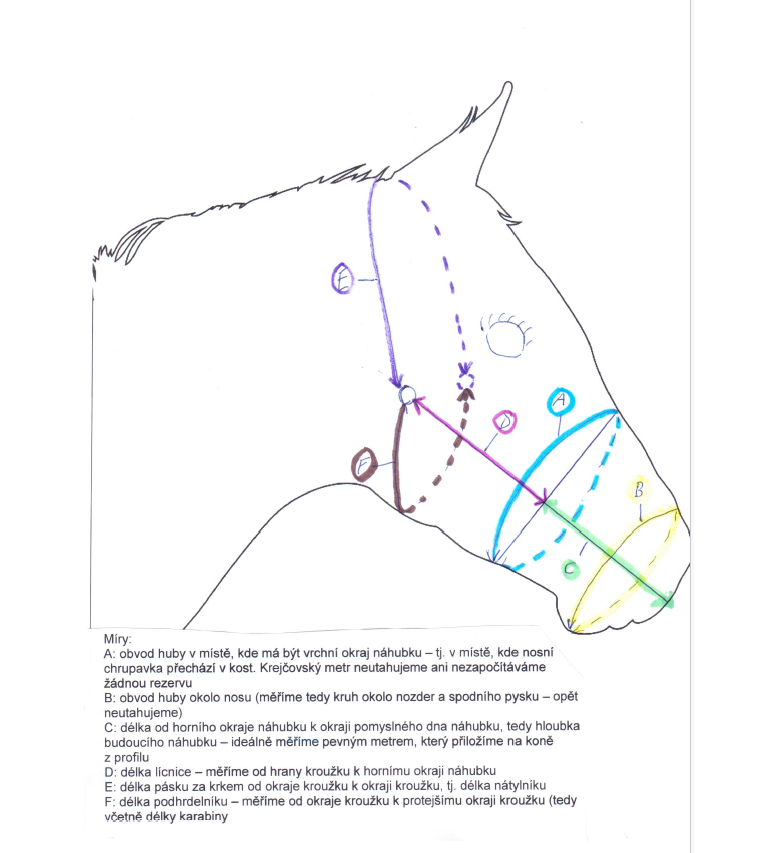
Your website has detailed instructions on measuring a horse before ordering. Why else are these measurements important?
Yes, correct measuring is the first step towards making a custom muzzle. Owners often find it quite difficult. They need a tape measure, ideally a dressmaker’s tape, a helper to photograph whether the correct points are being measured, and a cooperative horse. The horse usually does not want to cooperate. Playful ones try to steal the tape, sensitive ones resist, keep moving and disrupt the measuring in every possible way.
Even so, we do need to measure the horse. We cannot make a muzzle that fits without those dimensions. The photos show me whether the right points were measured, and I may ask for fresh measurements and photos.
Once the measurements are complete, I make a muzzle pattern for that horse. I keep it in case a new muzzle or a replacement part is needed.
Does prolonged wear cause rubbing under the muzzle? Can a horse drink while wearing it?
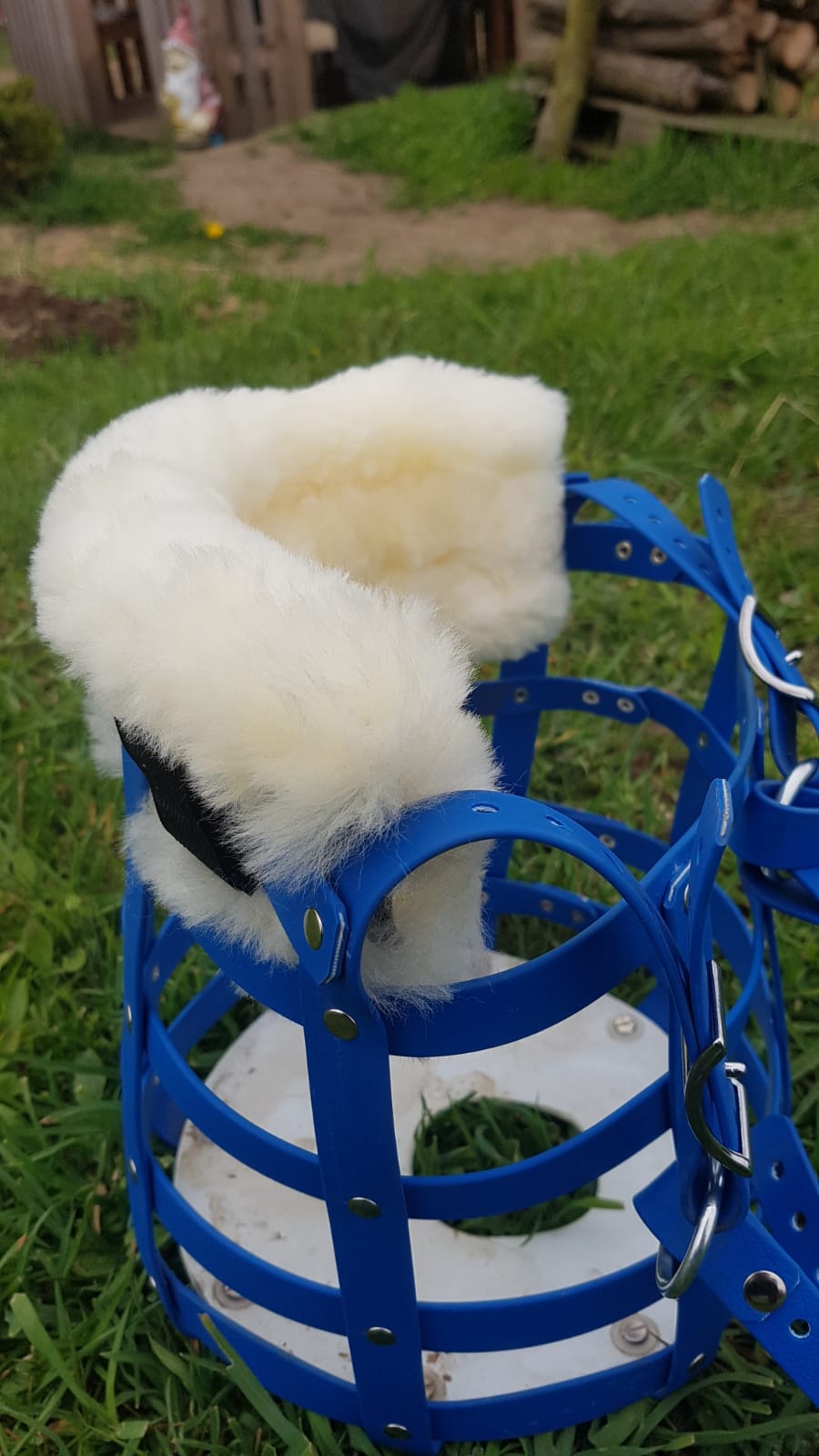
Rubbing is very common; in fact, it is the most common complication of muzzle use. If a horse wears it for only an hour or two of grazing a day, rubbing usually does not occur. But for horses wearing one for 12 or 24 hours a day, I recommend padding. Depending on sensitivity, we use thinner neoprene pads or real sheepskin for persistent rubbing. Sheepskin requires more care but offers a very high level of comfort.
Drinking with a muzzle is a crucial issue. If the horse uses a drinking bowl, its internal diameter must be measured so we can check against the muzzle size that drinking will be possible. Sometimes the muzzle really is larger than the bowl. The owner must then provide water in a trough or change the horse’s management instead of using a muzzle, for example by limiting grazing to a few hours a day.
If the drinking bowl is large enough, or the horses drink from a trough, drinking with the muzzle is no problem. They quickly work out how to do it.
As horse owners, we imagine worst-case scenarios in almost everything because we know what horses can do even in a perfectly safe paddock. What if a horse catches the muzzle on something or steps on it?
I completely understand. I own three horses myself and their safety matters to me. There are plenty of places to get caught, not just trees and fences. Some clever horses can even hook a hoof under the throatlash while scratching or trying to remove the muzzle. We bear this in mind and use two types of rivets: stronger ones on the basket and smaller ones on the headpiece and throatlash. We had the rivets load-tested, and a rivet releases under a pull of about 80 kg. This is enough to allow them to release in an emergency. It does mean extra work for the owner, who must refit a released rivet, but the benefit of keeping the horse safe is certainly worth it.
Are all FitGrazer muzzles made to measure?
Until now, yes. The owner had to measure each horse and send us the dimensions. We then made a pattern and a muzzle specifically for that horse.
But at the request of equestrian retailers, we are preparing something new for the grazing season: standard-sized muzzles.
I think five years of making custom muzzles has given us enough knowledge about horses’ and owners’ needs. We reviewed hundreds of patterns and, using our customers’ horse measurements, are starting to make standard-sized muzzles in six sizes. They retain most of the advantages of custom muzzles: they are airy, suitable even for horses with breathing difficulties, and have replaceable bases to suit the horse’s current needs and the richness of the pasture.